Seals and sea life. 5 minute read. Updated 3 October 2026.
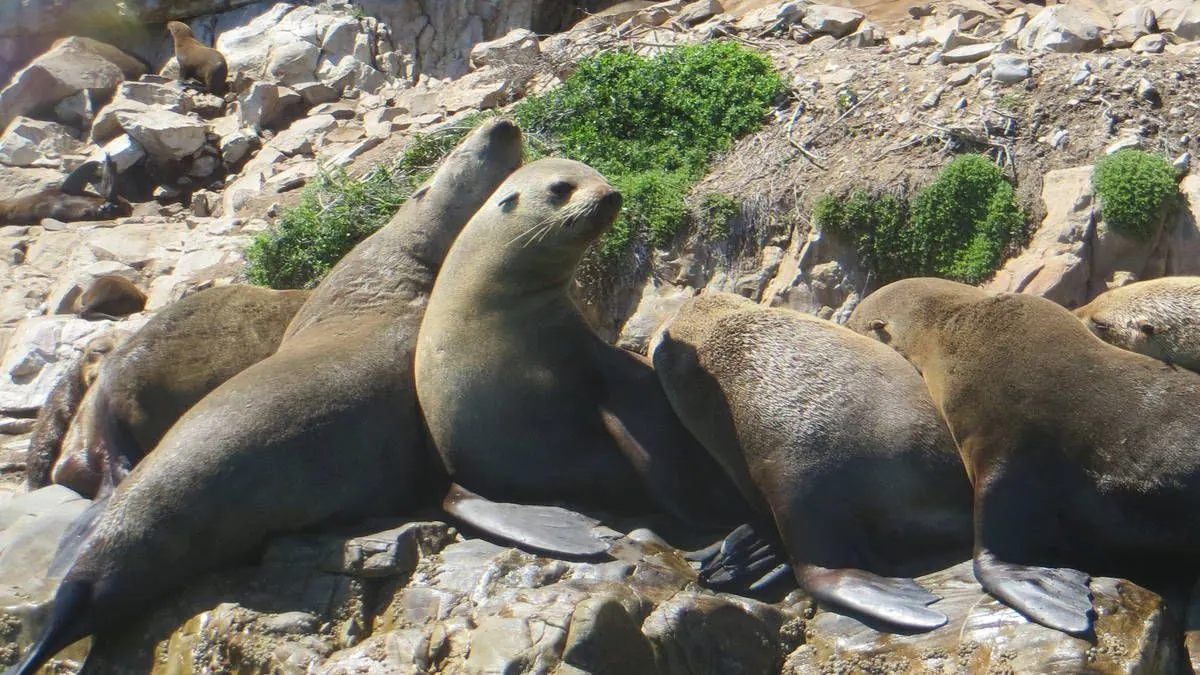
The Robberg seal colony is a group of several thousand Cape fur seals living on the rocks of the Robberg Peninsula, about 8 km south of Plettenberg Bay. The seals were hunted out here by the late 1800s and only began to return in the 1990s, so what you see today is a colony that has come back.
This guide covers the colony's history, how Cape fur seals live, and the best ways to see them.
Where the colony is
Robberg is a rocky peninsula at the southern end of Plettenberg Bay. It is a CapeNature nature reserve and World Heritage Site, with rocks that date back about 120 million years to the break-up of Gondwana.
The sea around it is protected too. The Robberg Marine Protected Area extends about 1.8 km offshore.
The name comes from Dutch and means seal mountain. The seals haul out on the rocks at the foot of the cliffs, where you can see them from the hiking trail above or from a boat on the water.
A colony that came back
Seals were plentiful enough here to give the peninsula its name.
Historical records suggest about 3,000 seals lived at Robberg around 1833. Indiscriminate harvesting wiped the colony out, probably by about 1890.
For roughly a century there was no colony. Then, in the 1990s, seals started to haul out at Robberg again. Researchers who counted them between 2000 and 2009 recorded the recovery:
- 2000: fewer than 300 seals.
- 2007: about 1,000.
- 2009: just over 3,100.
In those years few pups were born at Robberg, and the counts pointed to mostly non-breeding animals. Local estimates today are around 8,000 seals.
Commercial seal harvesting in South Africa was suspended in 1990, and the animals are protected by law.
Meet the Cape fur seal
The Cape fur seal's scientific name is Arctocephalus pusillus pusillus. It is found only in southern Africa, from southern Angola down the Namibian coast and around to Algoa Bay in the Eastern Cape.
Population estimates range from about 1.7 million to 2 million animals across some 40 breeding colonies, and the species is listed as Least Concern.
Fur seals are eared seals, which sets them apart from true seals:
- They have small external ear flaps.
- They can turn their hind flippers forward, so they walk and even gallop on land.
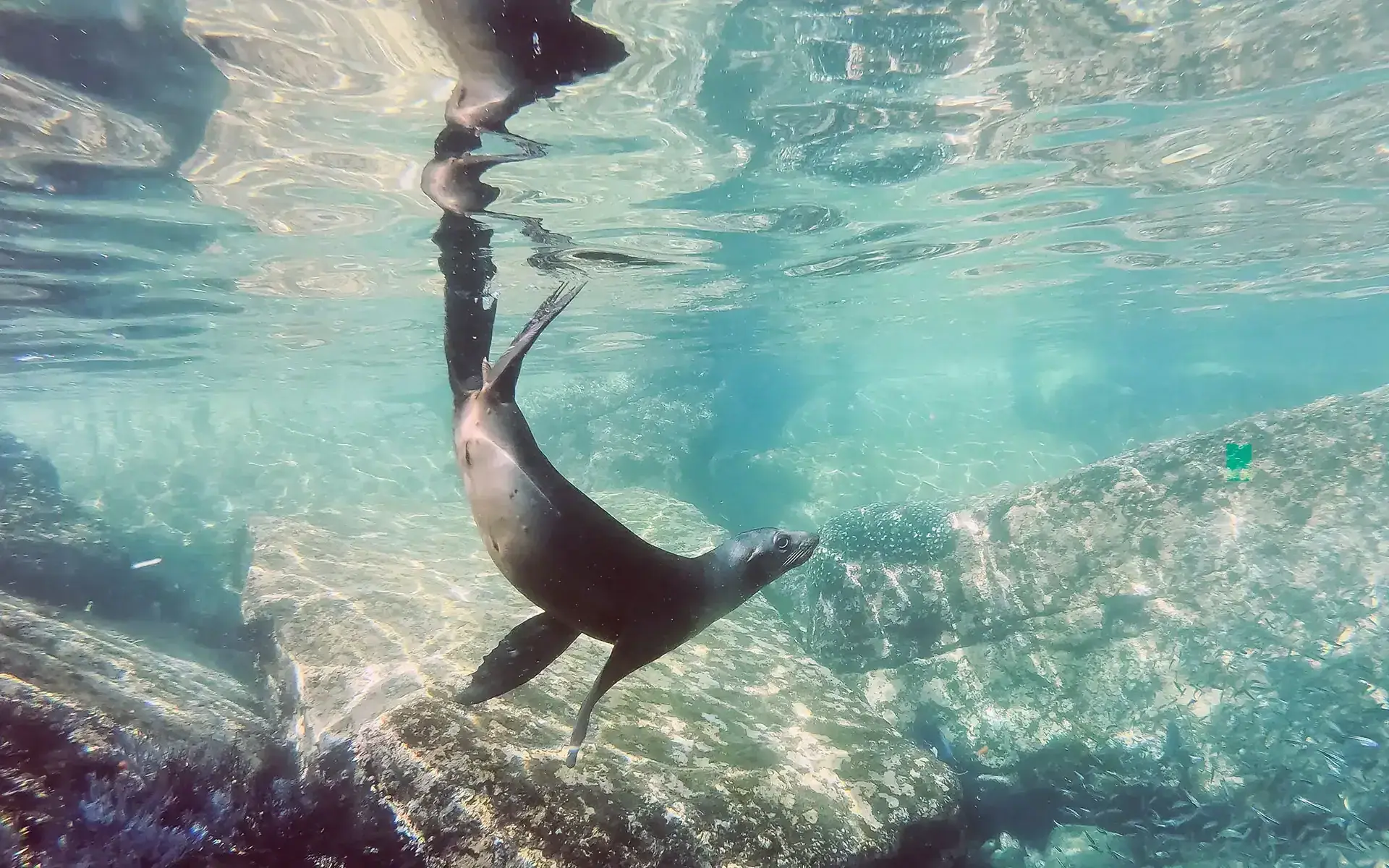
- They swim with their large front flippers, which makes them fast and agile under water.
Bulls and cows look very different. An adult bull can be over 2 metres long and averages around 250 kg. Cows are much smaller and lighter. A Cape fur seal can live for more than 20 years.
What they eat and how they dive
Cape fur seals hunt at sea. They eat mostly shoaling fish such as hake, horse mackerel, pilchard and anchovy, along with squid and the odd rock lobster.
They can dive to about 200 metres to find food. That is why the number of seals on the rocks changes from day to day: at any time, a share of the colony is out at sea feeding.
The seal year
Cape fur seals keep a yearly calendar.
- October: bulls come ashore at breeding colonies and claim territories.
- Late November to early December: pups are born, each weighing about 6 kg. Mating follows soon afterwards.
- Summer: mothers alternate between feeding trips at sea and nursing their pups on the rocks.
- Autumn: pups moult from black to grey.
- Winter: young seals start hunting for themselves, at the time of year when sardines pass along this coast.
For how this affects a visit, see the best time to swim with seals.
Seals and sharks
Great white sharks hunt seals at Robberg in winter. This is the reason swimming stops in June and July.
The seals do not make it easy for them. In 2019 a researcher spent more than 600 hours watching from the Robberg cliffs and saw seals gather in groups to mob the sharks. Only 5 of the 90 attacks she recorded succeeded, and seals in a group were about eight times less likely to be attacked or killed than seals on their own.
Threats to the colony
- Rabies: in 2024 rabies was confirmed in Cape fur seals, the first known outbreak in a marine mammal. Scientists traced the virus to a strain carried by black-backed jackals. Our safety page explains what it means for trips.
- Fishing: seals compete with fisheries for the same fish and are sometimes caught in fishing gear.
- Disturbance: people and dogs getting too close to seals resting on beaches.
- Strandings: young pups sometimes end up alone on local beaches.
We rescue stranded pups together with Tenikwa Wildlife Rehabilitation Centre, and we support the Plett Hope Spot, which was declared in December 2014. Our conservation page has the details.
If you find a seal on a beach, keep well back, keep dogs away and report it rather than trying to help it yourself.
How to see the colony
You have three options, from driest to wettest.
- On foot: the trails in Robberg Nature Reserve pass above the colony. The circuits are 2.1 km, 5.5 km and 9.2 km long.
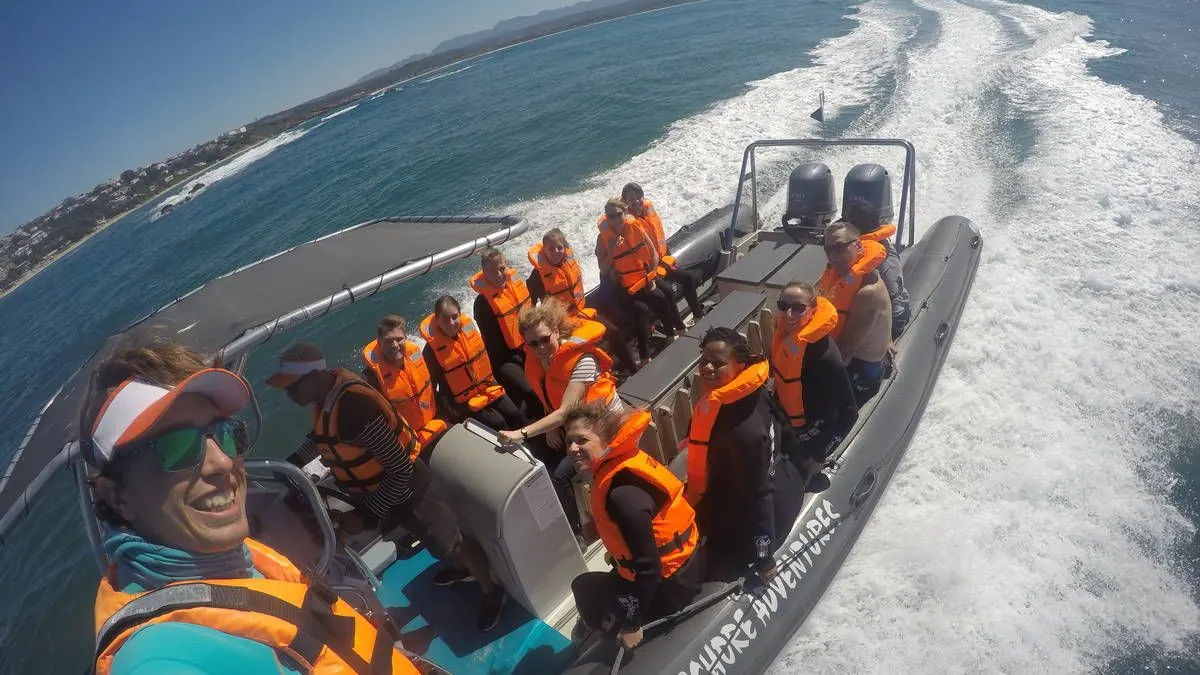
- By boat: seal viewing takes you along the coast to the colony. Sightings are guaranteed, and it runs all year.
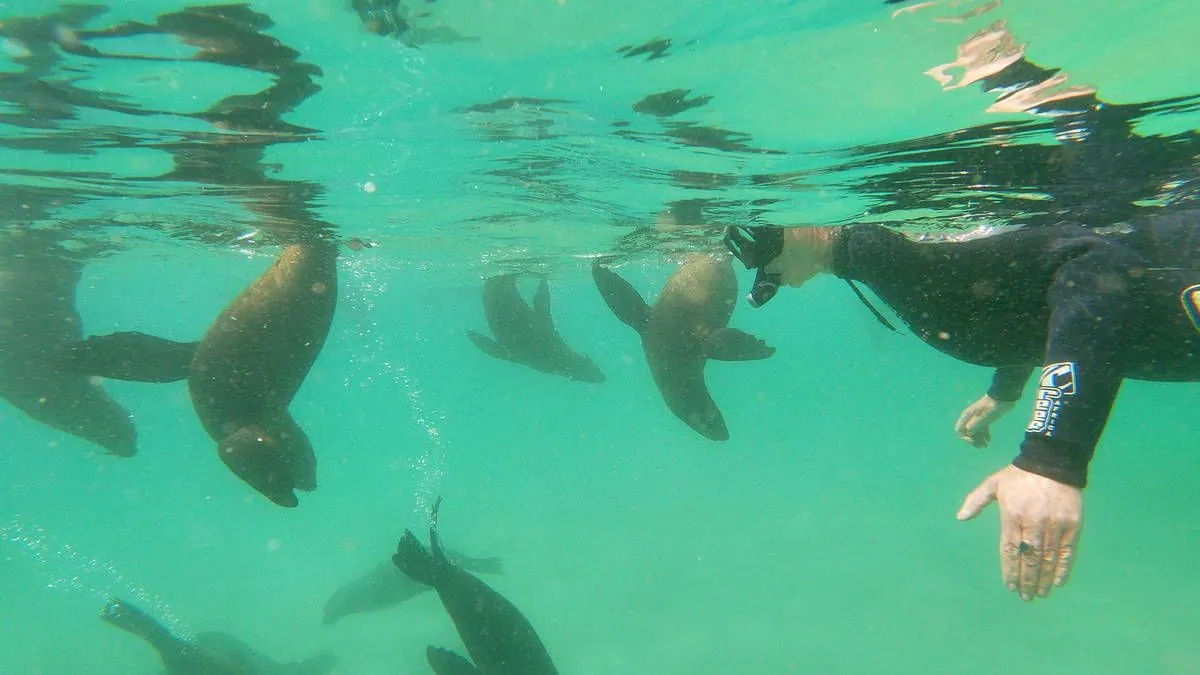
- In the water: the seal swim lets you snorkel with a guide while the seals come to look at you. It runs in every month except June and July.
Whichever you choose, the rule is the same: watch, don't touch and don't feed. The gallery shows what the colony looks like above and below the surface.
Quick answers
How many seals live at Robberg?
Several thousand. A published count in 2009 found just over 3,100 seals, and local estimates today are around 8,000.
What kind of seals are in Plettenberg Bay?
They are Cape fur seals, which are found only along the coast of southern Africa. They are eared seals, with small external ear flaps and the ability to walk on their flippers.
Are the seals at Robberg all year?
Yes. Seals are at the colony in every month, although the numbers on the rocks rise and fall as animals leave to feed.
When are Cape fur seal pups born?
Pups are born from late November to early December, with the peak in the first week of December. They are black at birth and turn grey within a few months.
Can you see the Robberg seals without going on a boat?
Yes. The hiking trails in Robberg Nature Reserve pass above the colony, so you can look down on the seals from the path.